

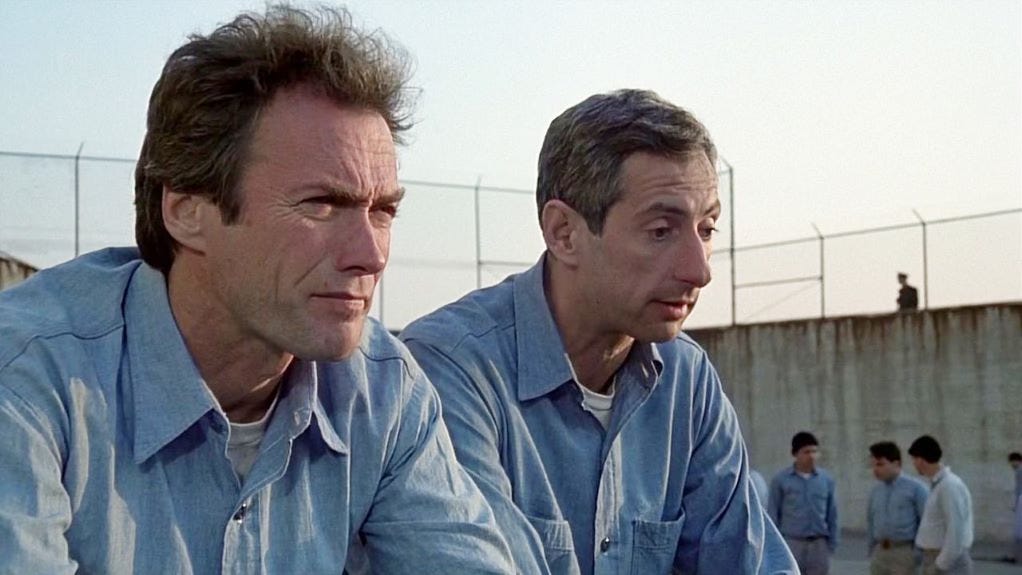
All things considered, the 11 (?!) original theatrical trailers included in the “Bonus” section on the Blu-ray in Kino Lorber’s two-disc (4K/Blu-ray) special edition, all starring Clint Eastwood, from A Fistful of Dollars (1964) through The Eiger Sanction (1975), make an excellent prelude to watching Escape From Alcatraz (1979), especially if it’s your first viewing.
The progression of trailers begins with a trailer that doesn’t even mention Clint Eastwood’s name to a stream of trailers that are built around his name and persona, which reminds me that I first became aware of Eastwood via The ABC Sunday Night Movie and its pan-and-scanned, edited for broadcast television, ad-supported presentations of Eastwood-starring films. After I graduated from high school and started seeing movies on my own, I remember being distinctly unimpressed with Every Which Way But Loose, though I loved seeing San Fernando Valley locations, where I lived at the time, on the big screen.
Released six months later, in June 1979, Escape From Alcatraz was a different story.
(For one thing, seeing Clint Eastwood’s naked backside shocked made me feel like an adult, no matter how brief the sighting. The movie was rated PG, which is a reminder that the PG rating was much looser in the 1970s than it is today.)
In May 2020, I revisited the film for the first time in years, during the early months of the global pandemic. Here’s what I wrote for Screen Anarchy:
Maybe it’s the pandemic, maybe it’s just me, but I empathized more than ever with a convicted criminal, locked up in an impregnable prison facility.
What timing! Recently, I revisited John Sturges’ The Great Escape, which pits good vs. evil in a grand, military adventure. Based on a true story, producer/director Sturges’ film follows heroic Allied soldiers as they strike back against evil Nazi forces.
For a change, please, consider producer/director Don Siegel’s muscular drama. Based on a true story, it follows convicted criminals as they endeavor to escape from the fabled Alcatraz Federal Penitentiary, located on an island a mile away from San Francisco, California.
Released in June 1979, the film featured the final teaming of Siegel with Clint Eastwood, a partnership that began in 1968’s Coogan’s Bluff, right after the actor scored worldwide box office hits, thanks to his partnership with filmmaker Sergio Leone. As I’ve written before, “Siegel’s riveting, mid-tempo style of action suited Eastwood well,” and they then made the off-beat, unpredictable Two Mules for Sister Sara (1970) and The Beguiled (1971), before capturing the cultural zeitgeist in Dirty Harry (1971).
That same year, Eastwood directed his first film, Play Misty For Me, and became a bigger cinematic presence than ever before as an actor and director. Siegel, meanwhile, helmed the fabulous thieving adventure Charley Varrick (1973), starring Walter Matthau; the very enjoyable thriller The Black Windmill, starring Michael Caine; the forlorn Western The Shootist (1976), starring John Wayne; and the spy thriller Telefon (1977), starring Charles Bronson.
For Eastwood, Escape From Alcatraz was sandwiched by populist comedies Every Which Way But Loose (1978) and Bronco Billy (1980). As it happens, the former was the first Clint Eastwood film I’d seen in a theater, and so the prospect of seeing him in a drama was very appealing in the summer of 1979.
Revisiting Escape From Alcatraz, which recently became available on Amazon Prime Video, was a complete pleasure, though I’d forgotten how much of the film unfolds with very little action, per se.
The prison, operated from 1934 until 1963, was known as a maximum-security facility where troublemakers were held (shades of The Great Escape). Unlike John Sturges’ film, however, the protagonist here, Frank Morris (Eastwood), is no hero.
Instead, he’s a career criminal who has escaped from other prisons before, which is why he was transferred to Alcatraz. The steely-eyed, stiff-jawed warden (Patrick Magee, also in Siegel’s Telefon) lays down the law to Morris, who steals a fingernail-clipper right off the warden’s desk during their brief meeting.
Clearly, Morris has an instinctual desire to escape. The film supports that notion, showing guards who are not entirely monstrous and featuring fellow prisoners who are sympathetic and supportive. Naturally, the warden is evil -- Magee makes for a smug, villainous figure -- as well as some of the guards and a few fellow prisoners.
For the most part, though, it feels like the prison is pulling for Morris to defy all the odds and escape with his life. Those empathetic chords reach out and embrace the viewer; we know that Frank Morris is a criminal, but it’s Clint Eastwood, really, and we pulled for him in the 1970s.
Displaying his subtle, supreme mastery of the craft of filmmaking, director Don Siegel employs superb control of the frame, constantly inviting the viewer into the action, even when that action is expressed entirely on Eastwood’s face.
The power of the film is not diminished, even when watching on a small screen.
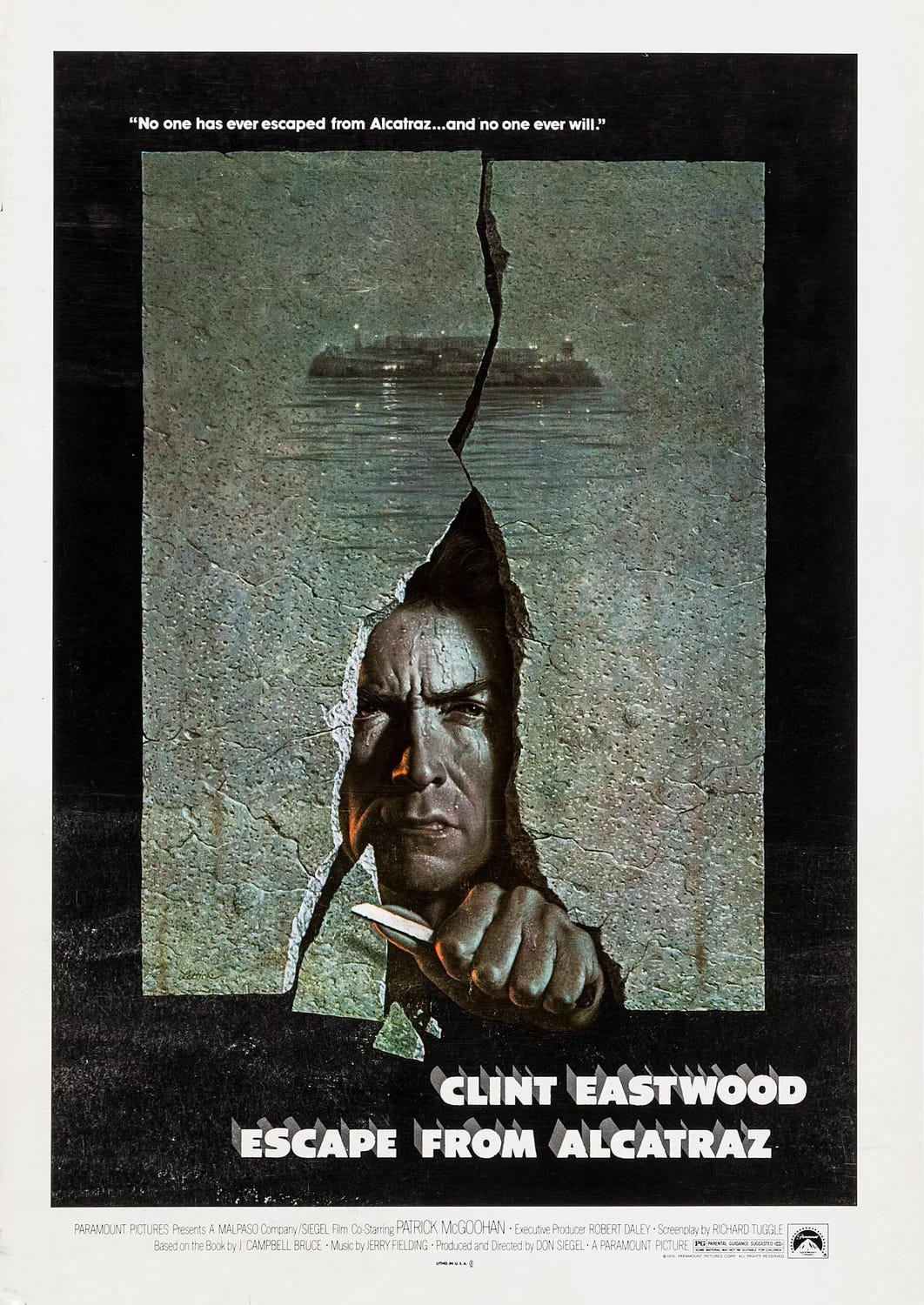
Kino Lorber’s 4K looks superb, especially in the many shadowy scenes that predominate the early scenes, as well as the escape sequence itself. According to the packaging: “The HDR/Dolby Vision Master was remastered by Paramount Pictures -- from a 4K scan of the original camera negative.”
The special features on Kino Lorber’s edition are composed of an excellent audio commentary by film historians Steve Mitchell and Nathaniel Thompson, the latter of whom owns the outstanding review site Mondo Digital. Two interviews, which were also included on the 2022 home video release, are included here as well.
Their content is complementary: the first with screenwriter Richard Tuggle, who talks about how he came across J. Campbell Bruce’s book, first published in 1962, prompting him to write his first screenplay. The second features actor Larry Hankin, who plays a character who was directly involved in the escape attempt, and is quite amusing as he talks about how he was cast and tells stories from the location shooting.
Astute observation. I've watched the 4K twice now and I appreciate even more so how Siegel 'controls the frame' and allows Eastwood to move through scenes, observing little details that become more pertinent as the narrative develops.